Bernard Arnault Net Worth
Amounts mentioned are estimates based on public sources and can vary depending on methodology (income, assets, debt) and update date.
Introduction
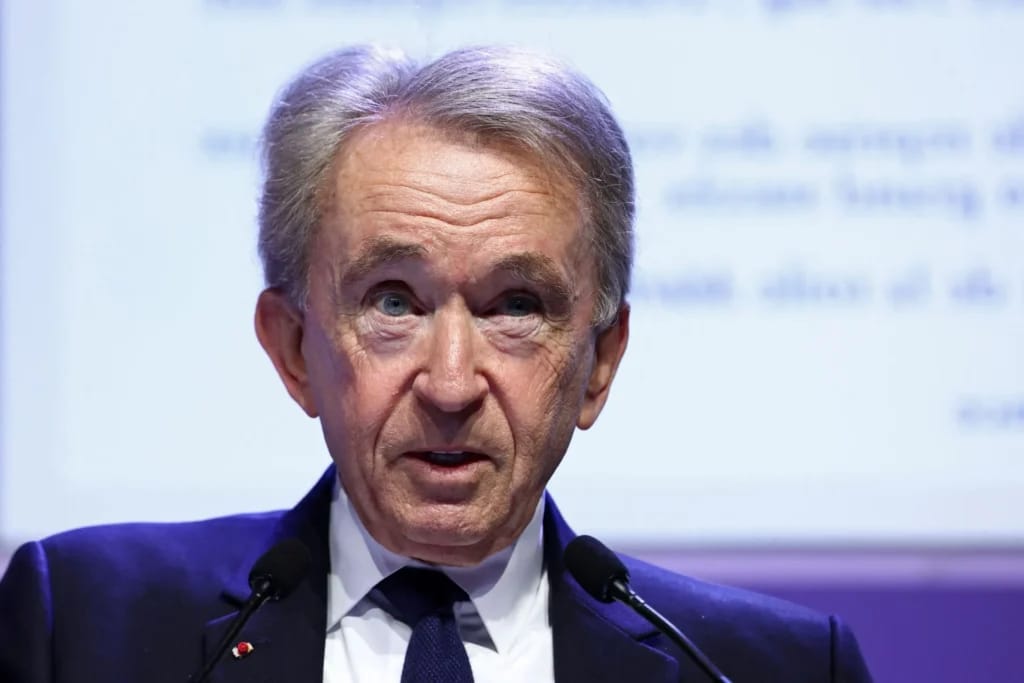
Bernard Arnault is the French luxury magnate at the head of the LVMH group (Moët Hennessy Louis Vuitton). At 74 years old, he ranks among the wealthiest people in the world, regularly competing with Elon Musk for the top spot on the billionaires ranking. CEO of LVMH and Europe’s wealthiest person, Bernard Arnault has built a luxury empire whose value continues to grow. His colossal fortune, estimated at over €180 billion in 2025, reflects the spectacular success of his group and his dominant position in the global luxury industry.
 Bernard Arnault
The Growth of His Empire
Bernard Arnault’s rise began in the 1980s with a series of bold acquisitions. In 1984, he acquired the Boussac group (owner of Christian Dior), laying the first stone of his empire. A few years later, he took control of LVMH, born from the merger of Louis Vuitton and Moët-Hennessy, by skillfully outmaneuvering the other shareholders. His growth strategy has always been centered on expansion through acquisitions: under his leadership, LVMH has acquired numerous prestigious houses, from fashion to jewelry.
Among the key acquisitions are the leather goods brand Céline (1988), the jeweler Bulgari, the watchmaker TAG Heuer, and more recently the American jeweler Tiffany & Co. in 2021 (one of the largest acquisitions in the history of luxury). These buyouts, combined with the internal development of historic brands like Louis Vuitton or Christian Dior, have propelled LVMH’s market capitalization to record heights. Today, the group counts more than 70 luxury houses and dominates sectors ranging from haute couture to spirits. This phenomenal growth in LVMH’s scope has directly fueled Bernard Arnault’s fortune, whose wealth is primarily tied to the value of his luxury empire.

Estimate of His Net Worth in 2025
In 2025, Bernard Arnault’s fortune reached record levels. At the start of the year, his personal wealth was estimated at around €190 billion, which temporarily made him the richest man on the planet. This astronomical sum placed him neck and neck with Elon Musk, the head of Tesla and SpaceX – by comparison, Musk’s fortune hovered around €185 billion during the same period. Bernard Arnault thus occupied the world’s #1 spot among billionaires at the start of 2024, a position he has alternated with Musk since late 2022 depending on stock market fluctuations.
To put it in perspective, his fortune far exceeds that of other giants like Jeff Bezos (Amazon) or Bill Gates (Microsoft) over the same period. However, the year 2025 was marked by contrasting movements: after a historic peak in spring, Arnault’s fortune slightly declined by year-end due to a slowdown in the Chinese luxury market. Despite these variations, in 2025 his fortune remains colossal, at around €170.8 billion, keeping him in the top 3 of the world’s greatest fortunes. These figures illustrate the scale of his wealth, equivalent to the GDP of certain countries, and the speed at which it can evolve with market movements.

The Main Sources of His Income
Bernard Arnault’s wealth comes almost entirely from his LVMH group, of which he and his family hold nearly half the capital. LVMH is a diversified luxury empire, but some segments are more profitable than others. The Fashion and Leather Goods division is the central pillar of the group’s revenue – it includes flagship brands like Louis Vuitton, Dior, Fendi, Celine, and Givenchy. This segment alone represents approximately half of LVMH’s revenue, with very high margins.
Louis Vuitton, for example, is the group’s most profitable brand, generating over 20 billion euros in annual sales on its own, a record in the luxury sector. This is followed by the Wines and Spirits division (Moët & Chandon, Dom Pérignon, Hennessy, Château d’Yquem…), Perfumes and Cosmetics (Parfums Christian Dior, Guerlain, Sephora…), and Watches and Jewelry (Bulgari, Tiffany & Co., TAG Heuer…). Each of these branches contributes to LVMH’s profits, but it is fashion and leather goods – driven by global appetite for luxury bags and accessories – that remains the group’s cash cow.
 Bernard Arnault and Donald Trump
Finally, the selective retailing segment (DFS stores, La Samaritaine, and the Sephora brand) adds another significant source of revenue. In summary, the main drivers of Arnault’s fortune are LVMH’s iconic luxury brands, whose commercial success translates into record profits and an ever-increasing market capitalization.
His Investments and Personal Assets
While Bernard Arnault owes the bulk of his fortune to LVMH, he has also diversified his assets through other investments over the years. Through his family holding company (Groupe Arnault, renamed Financière Agache), he has made strategic investments outside the luxury sector. For example, he was one of the early investors in Netflix back in 1999, sensing the platform’s potential long before its global explosion. He also ventured into large-scale retail by taking a stake in Carrefour in the 2000s (which he subsequently sold).
Arnault also owns several French media outlets: he holds the economic daily Les Échos, the newspaper Le Parisien, and the Radio Classique station, thereby asserting his presence in the media landscape. His personal assets also include sumptuous tangible properties. Notable examples include his 2,000 m² private mansion in Paris, in the 7th arrondissement, acquired for tens of millions of euros, as well as his luxury chalet in Courchevel and his villas in Saint-Tropez.

A passionate art lover, Bernard Arnault owns a leading contemporary art collection and funded the construction of the Fondation Louis Vuitton, a modern art museum in Paris, a symbol of his patronage and attachment to art. He travels aboard an impressive yacht over 100 meters long (the Symphony), estimated to be worth over €130 million, and a Bombardier Global Express private jet for his travels. All of these investments and private properties, while representing a smaller share compared to LVMH’s value, contribute to diversifying his financial empire and cementing his status as a cosmopolitan billionaire.
In short, Bernard Arnault’s assets are not limited to luxury brands: they extend from tech to media, through prestige real estate and art, reflecting the vision of a shrewd and passionate businessman.
The Influence of the Stock Market on His Wealth
Bernard Arnault’s fortune is intimately tied to LVMH’s stock market health. Holding a majority stake in the group’s capital, every fluctuation in the LVMH share price has a direct impact on his net worth. When LVMH’s stock soars, Arnault’s wealth can gain billions within days. This was the case at the start of 2023 when the stock reached historic highs, pushing his fortune past the symbolic threshold of $200 billion.
Conversely, a decline in LVMH’s share price translates into an equally spectacular drop in his paper wealth. For example, during the year 2025, the slowdown in luxury goods sales in China caused LVMH’s stock to fall by about 20% from its peak. Such a correction caused Bernard Arnault’s fortune to shrink by approximately $50 billion in a matter of months, illustrating the volatility to which the largest stock-market fortunes are exposed.
 Bernard Arnault and Donald Trump
Likewise, a single exceptional trading session can upend the billionaire rankings: in January 2024, a surge of +12% in LVMH’s stock in a single day swelled Arnault’s net worth by more than $20 billion, briefly restoring his title of the world’s richest man.
These financial roller coasters make clear that Arnault’s fortune, though gigantic, is not static – it evolves with market movements. However, Bernard Arnault adopts a long-term strategy: he does not sell his LVMH shares (the heart of his empire) to cash in these virtual gains, preferring to let his assets grow with the conviction that the underlying trend for luxury remains upward. In summary, the stock market acts as a barometer of Bernard Arnault’s wealth: with his empire worth hundreds of billions, market movements can cause him to gain or lose staggering sums, without undermining the solidity of his financial position.
Succession and Inheritance
At the head of a family empire, Bernard Arnault has long been preparing his succession to ensure the continuity of LVMH. Father of five children, he has involved all of them in the group in order to train the next generation of luxury leaders. Delphine Arnault, the eldest, has held the position of CEO of Christian Dior Couture since 2023, after proving herself at Louis Vuitton. Antoine Arnault, her older brother, is responsible for the group’s communication and image at LVMH, and runs the Christian Dior SE family holding company (which controls LVMH).
The younger ones are not left out: Alexandre Arnault led the Rimowa luggage brand and then worked at Tiffany & Co. before joining an LVMH division, Frédéric Arnault was CEO of TAG Heuer (watches) and is taking on new responsibilities at LVMH (he now oversees the Loro Piana house), while Jean Arnault, the youngest, focuses on watchmaking within Louis Vuitton. Bernard Arnault has established a kind of “benevolent competition” among his children, each managing a part of the empire to prove themselves. Officially, no successor has yet been designated to take over from him at the head of the group.
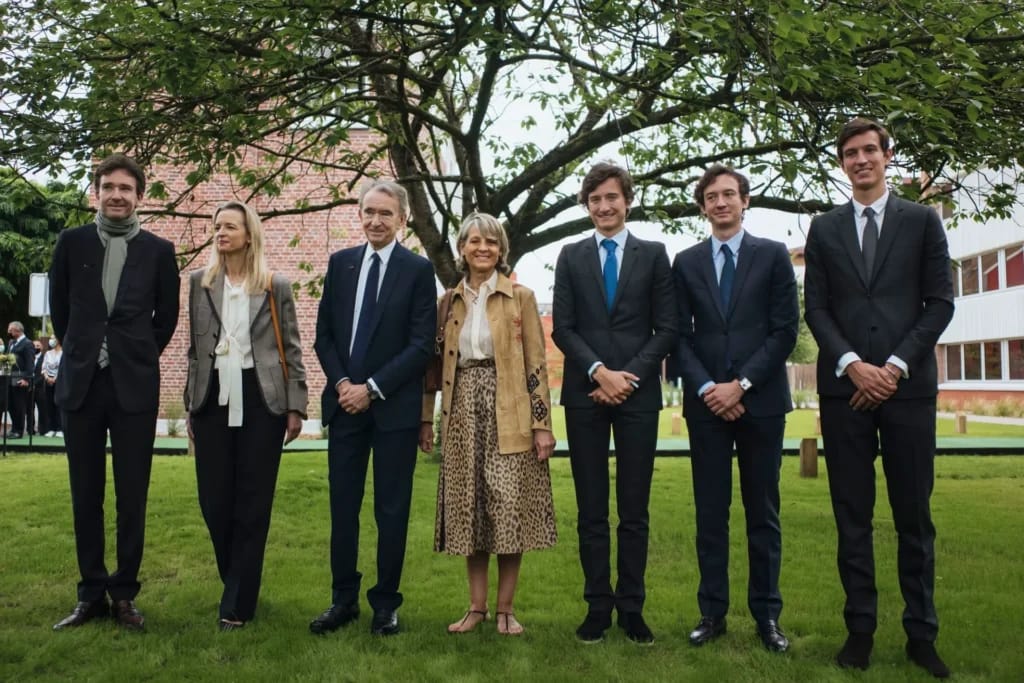 The Arnault family
However, many observers are betting on Delphine (often presented as the most experienced in the core luxury business) or Antoine (for his role at the holding company and his diverse experience) as natural successors. In any case, Arnault has taken concrete steps to organize the transfer of his assets: as early as 2017, he transferred 75% of the LVMH shares he held to his children (and nephews), in bare ownership, while retaining usufruct and voting rights for as long as he is alive. This ingenious estate planning ensures the unity of the family clan and avoids succession disputes, while minimizing inheritance taxes.
Furthermore, in 2023, he had the statutory age limit at LVMH modified, allowing him to remain CEO beyond the age of 75 and potentially until 80. This indicates that he wishes to continue steering his group for a few more years, to finalize the handover of power. In short, Bernard Arnault is meticulously preparing the future of LVMH: he is training his heirs within the company and ensuring that his colossal fortune remains in trusted hands. His ambition is for the Arnault empire to remain a prosperous family empire for generations to come, in the image of enduring industrial dynasties.
Summary
Bernard Arnault, CEO of LVMH, is one of the world’s greatest fortunes, often in competition with Elon Musk. His luxury empire, built on strategic acquisitions such as Dior and Tiffany & Co., has propelled his fortune to over €180 billion in 2025. As the main shareholder of LVMH, he derives the bulk of his wealth from the performance of iconic brands like Louis Vuitton and Dior. Despite stock market volatility, he remains a key player in global luxury. Preparing his succession, he involves his five children in the business to ensure the continuity of his family empire.
FAQ
What is Bernard Arnault’s net worth in 2025?
In 2025, Bernard Arnault’s net worth is estimated at around €180 to 190 billion. This figure can vary depending on fluctuations in LVMH’s stock price. It even reached approximately $200 billion (nearly €185 billion) at its peak, making Bernard Arnault one of the rare businessmen to have crossed this stratospheric threshold.
Is Bernard Arnault the richest man in the world?
He has been on several occasions. At the end of 2022 and beginning of 2023, then again at the start of 2024, Bernard Arnault held the rank of the world’s richest man, surpassing Elon Musk thanks to the rise in LVMH’s stock. However, this title of global number one alternates primarily between him and Elon Musk depending on the valuation of their respective companies. At year-end 2025, Arnault generally featured in the Top 3 of the world’s greatest fortunes, alongside Elon Musk and, depending on the period, billionaires like Jeff Bezos.
Where does Bernard Arnault’s wealth come from?
Bernard Arnault’s wealth comes primarily from LVMH, the luxury conglomerate he built. He derives the bulk of his income from his majority stake in LVMH (he and his family control approximately 47% of the group’s capital). The performance of brands like Louis Vuitton, Dior, Fendi, Moët Hennessy, or Sephora generates considerable profits that are reflected in LVMH’s stock market value – and therefore in Arnault’s fortune.
Outside of LVMH, he has some investments and assets (media, real estate, art), but these remain modest compared to the valuation of his luxury empire. In summary, the primary source of his wealth is his LVMH empire, which dominates the global luxury industry.
Which luxury brands does Bernard Arnault own through LVMH?
Through LVMH, Bernard Arnault oversees a portfolio of around sixty prestigious brands. It includes iconic fashion and leather goods houses: Louis Vuitton, Christian Dior, Fendi, Celine, Givenchy, Loewe, Kenzo, etc. In wines and spirits, LVMH notably owns Moët & Chandon, Veuve Clicquot, Dom Pérignon, Hennessy, and Château Cheval Blanc. The watches and jewelry division includes jewels such as Bulgari, Tiffany & Co., TAG Heuer, Chaumet, and Hublot. The group is also present in perfumes and cosmetics with Parfums Christian Dior, Guerlain, Givenchy Parfums, as well as in selective retailing with Sephora (cosmetics retail chain) and DFS (duty-free stores).
This list is not exhaustive, but it illustrates the breadth of the Arnault empire, covering all universes of luxury, from haute couture to champagne. It is the combined success of all these brands that makes LVMH’s strength and value – and consequently Bernard Arnault’s fortune.
How is Bernard Arnault preparing his succession at LVMH?
Bernard Arnault has long been anticipating the transfer of his empire. He has involved each of his five children in the business, entrusting them with leadership positions in different subsidiaries so that they gain experience. Delphine runs Dior Couture, Antoine manages the group’s communications and the family holding company, while Alexandre, Frédéric, and Jean also hold key positions at Tiffany, Loro Piana, Louis Vuitton, or other LVMH entities. Rather than naming a single successor now, Arnault seems to encourage collective family management, while maintaining competition among his children to push them to excel.
On the asset side, he has already transferred the majority of his shares to his heirs while retaining voting rights, in order to ensure a smooth succession. At the same time, he had the age limit raised to be able to remain CEO for a few more years, until his succession is finalized. In short, the succession is being prepared methodically: Bernard Arnault ensures that his children master the business and that family unity is maintained, so that LVMH continues to thrive after him under the Arnault governance.
Editorial methodology
The estimates published by Lama Fortune rely on public sources, media references, and sector comparisons. They are provided for informational purposes only and do not constitute financial advice.